KEY MECHANICAL TAKEAWAYS: AT A GLANCE.
100% Factory Service Manual Verification: Never rely on dealership sales talk or unverified forum threads. Every transfer case disengagement sequence must match verified OEM service bulletins.
Mandatory Proportional Braking Compliance: Supplemental breakaway braking systems are legally mandated across North America to synchronize stopping power, prevent coach brake overheating, and protect against highway breakaway disconnects.
GCWR & Class IV/V Hitch Protection: Always verify your vehicle's actual CAT scale curb weight against your motorhome's Gross Combined Weight Rating to maintain a 15% safety buffer.
Certified Frame-Mounted Hardware: Ensure your tow bar, baseplate steel tabs, and safety cables share matching Class IV (5,000 lbs) or Class V (10,000 lbs) load ratings.
What dog, cat, and small pet owners need to know before crossing in a motorhome, fifth wheel, or travel trailer — including pet paperwork, border prep, and route considerations.
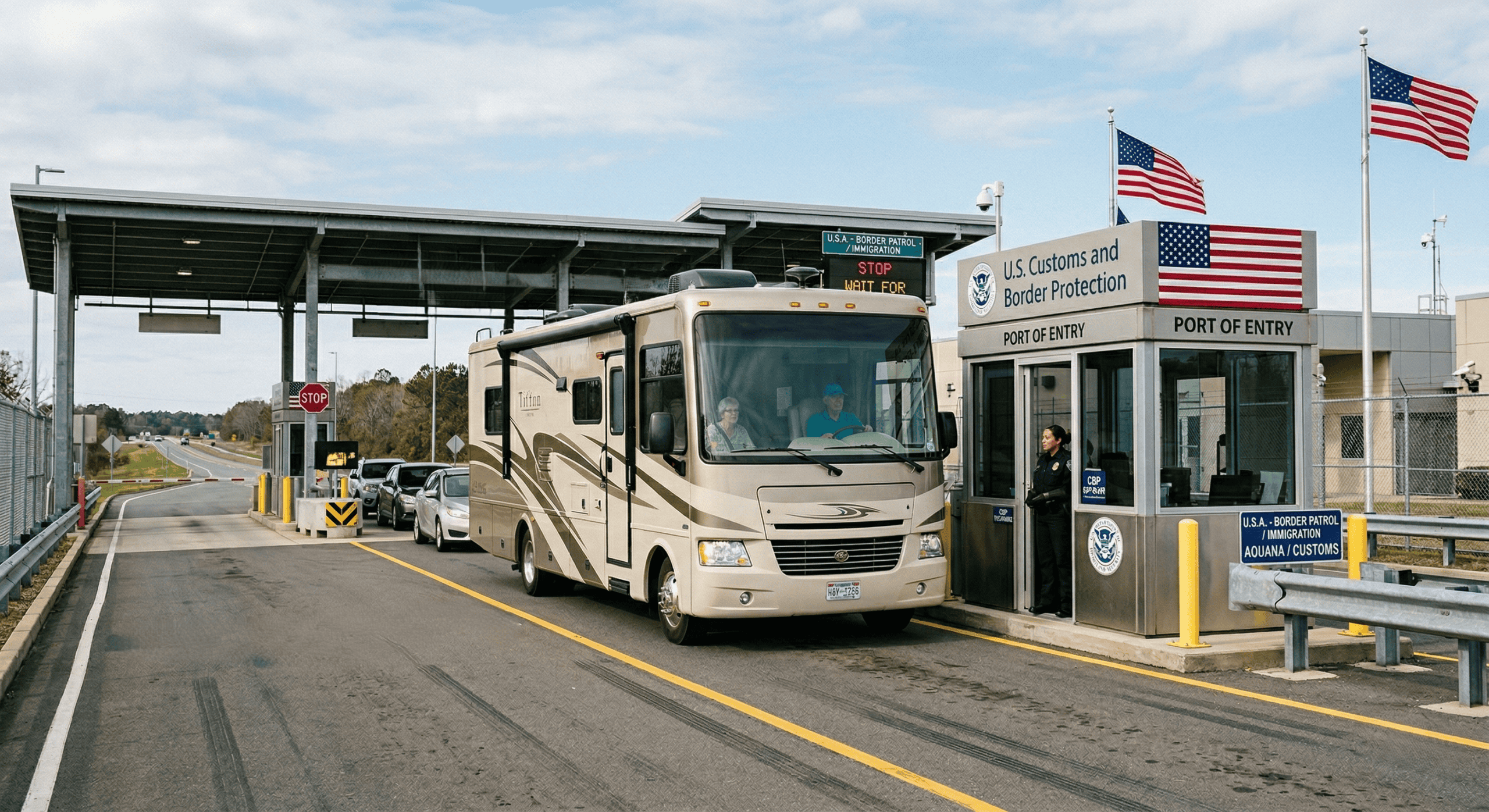
Crossing the U.S.–Canada border in an RV is usually very manageable, but it gets much easier when you prepare ahead of time. That is especially true if you are traveling with pets. Canada and the United States both have pet-entry rules, and RV travelers also need to think about food declarations, vehicle size, route choice, and keeping the right documents easy to reach at the inspection booth.
This guide covers what to have ready when going from the U.S. into Canada or from Canada into the U.S. Because we all love taking our furry companions with us, special attention is given to requirements to cross with dogs, cats, and other small animals. It also includes practical RV-specific tips that many pet travel articles leave out, like which crossings may be a bad fit for certain large rigs and why choosing the right port of entry matters.
In This Guide
- Crossing from the U.S. into Canada with pets
- Crossing from Canada into the U.S. with pets
- What RV travelers should know at the border
- Crossings that may be a bad fit for some RVs
- What to keep in your border binder
- Sample forms and images to include
- Official resources and links
- FAQ
At-a-Glance Pet Rules
| Direction | Dogs | Cats | Rabbit / Small Animal |
|---|---|---|---|
| U.S. → Canada | Rabies certificate for dogs over 3 months, pit bull type breeds banned in Ontario | Rabies certificate generally needed for cats over 3 months | Must be in good health, Rabies Certificate in certain cases (Check CFIA’s pet import tool before travel) |
| Canada → U.S. | Must be 6 months old; CDC Dog Import Form receipt, Microchip; | Must appear healthy; Certificate of Veterinary Inspection recommended, Rabies Certificate required in many states (but not at Border) | Subject to Inspection; must not show signs of disease |
Crossing From the U.S. Into Canada With Pets
Canada requires the right paperwork for pets entering the country, and missing documents can create delays or even lead to refusal of entry. If you are traveling in a motorhome, it is smart to keep all pet paperwork together with your own travel documents rather than buried in a cabinet or storage bay.
Dogs entering Canada
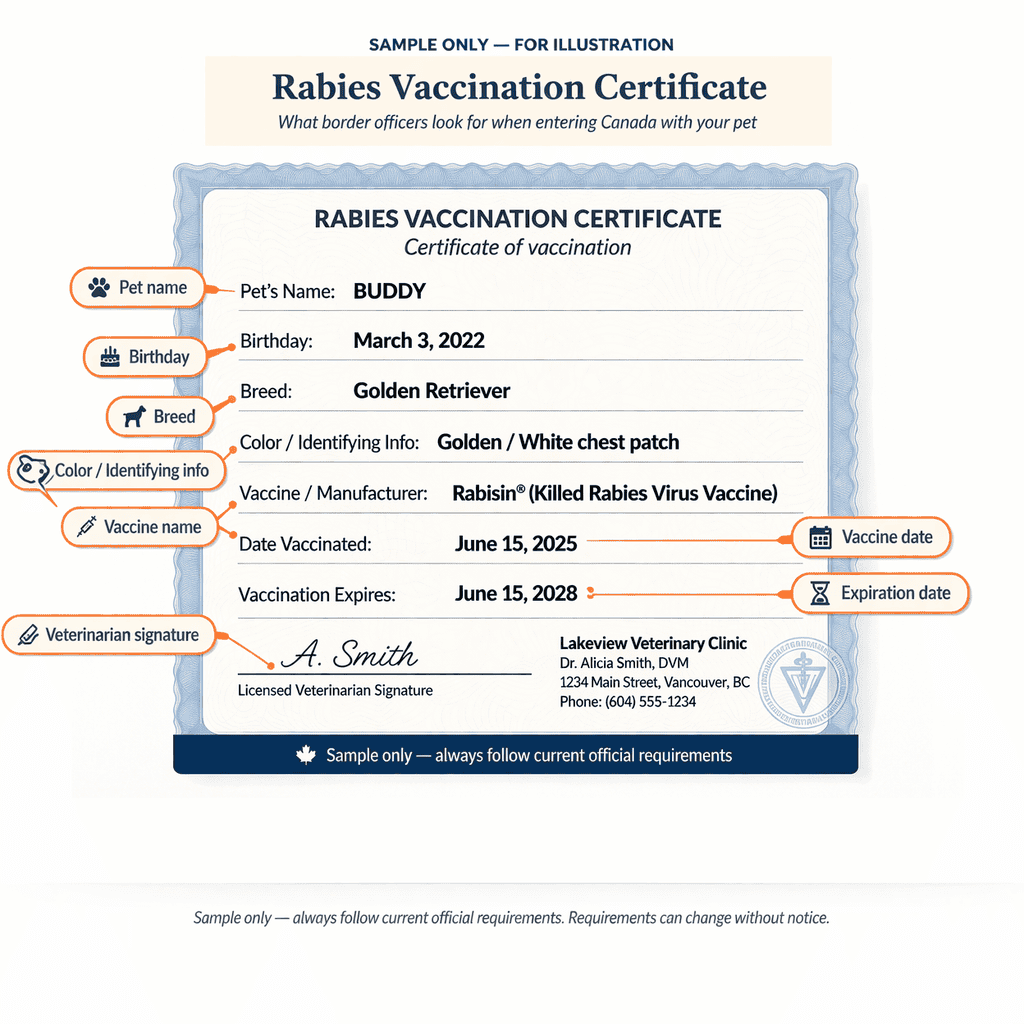
For most pet dogs coming from the United States, the important document is a current rabies vaccination certificate. For a typical RV traveler bringing their own companion dog, this is the key item border officers may want to see. If your dog is a puppy less than 3 months, you will need a proof of age document to provide the agent.
Cats entering Canada
Pet cats entering Canada generally should travel with a rabies vaccination certificate if they are 3 months of age or older. Kittens under 3 months are typically exempt from the rabies vaccination requirement, so bringing a proof of age document is required.
Rabbits and small animals entering Canada
Rabbit and small-animal rules can be more specialized than dog and cat rules, but typically they just need to be in good health with no signs of disease. Owners should verify current details directly with the Canadian Food Inspection Agency Tool before departure. If you are traveling with a bird, you will need a health certificate endorsed by a USDA Veterinarian otherwise a quarantine is likely. Check into your specific species on the CFIA Site.
Pet food entering Canada
This matters more in an RV than many travelers realize. Canada expects travelers to declare food, plant, and animal products, including pet food and treats. Keep pet food in its original commercial packaging and be prepared to answer what type of food you are carrying in the coach or tow vehicle. The Canadian Food Inspection Agency (CFIA) requires that pet food entering Canada be manufactured in the United States, with a maximum allowance of 20 kg per animal. The pet must be present at the time of entry, and the food must be intended solely for that animal. Homemade pet food is typically not permitted.
Crossing From Canada Into the U.S. With Pets
For many pet owners, the trip into the United States is the side that needs the most attention — especially if you are bringing a dog back across the border.
Dogs entering the United States
Dog owners should be aware of the CDC Dog Import Form, a free registration form submitted online for bringing your dog into the US from a rabies-free country. Before arriving at the U.S. border, your dog should have a valid CDC Dog Import Form receipt, and you should be ready to show it on your phone or on paper. Your dog should also be microchipped which will be scanned to identify them. It is not required, but we also recommend that you travel with general vet records and rabies paperwork as backup documentation.
Cats entering the United States
Cats must appear healthy on arrival in the United States. The federal government does not generally require a cat rabies certificate for entry into the U.S., but your destination state may have its own animal-health rules. It is still smart to travel with veterinary documentation in case you are asked follow-up questions.
Rabbits and small animals entering the United States
If you are returning to the U.S. with a rabbit or other small animal, they will be inspected for health and any signs of disease. There is no specific paperwork required, but depending on your specific species, verify both federal guidance and any state-level rules that may apply where you are headed. These rules are less standardized than dog-entry requirements.
What RV Travelers Should Know at the Border
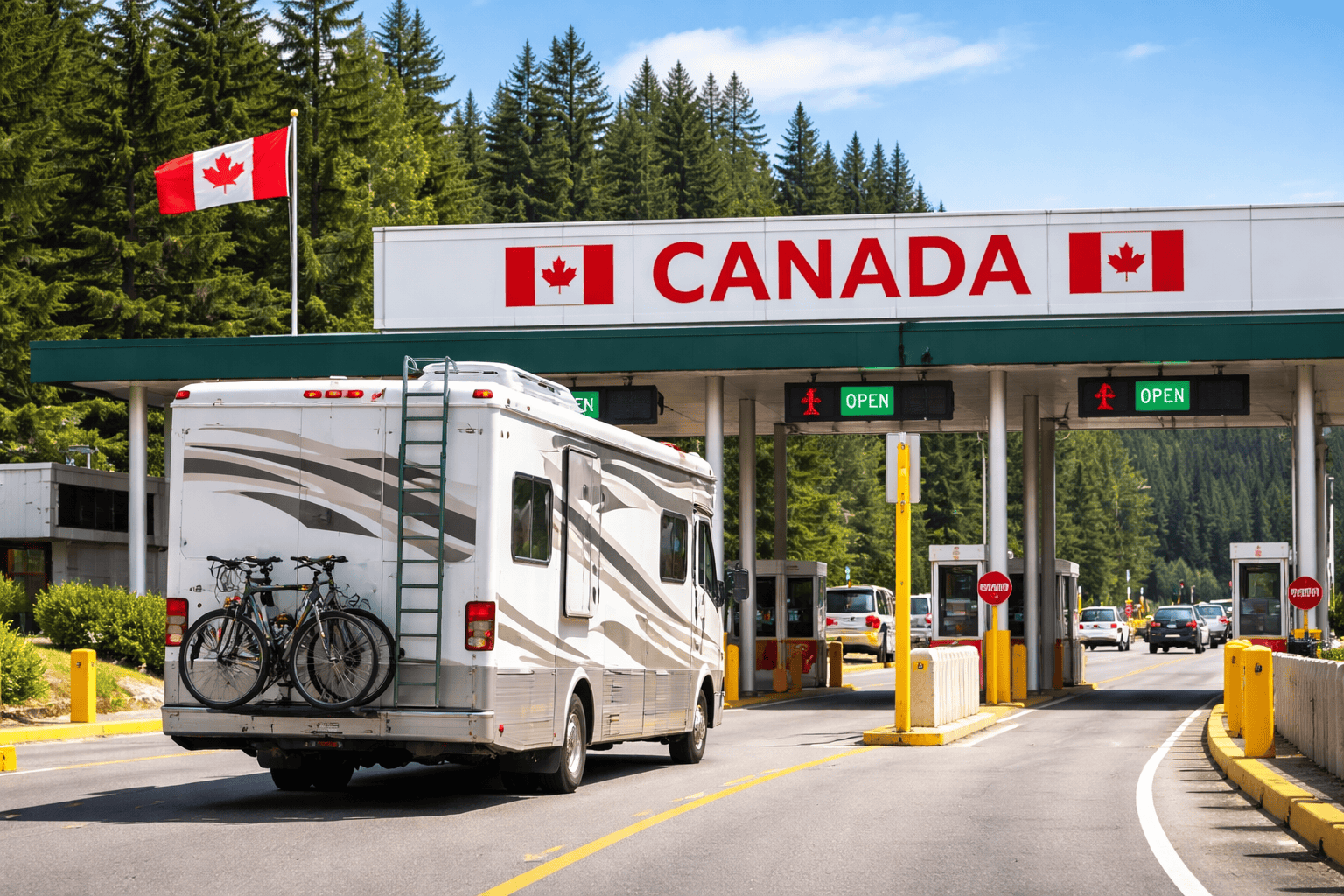
Most RV travelers do not need a special “RV lane.” In general, a personal-use motorhome, travel trailer, or fifth wheel is handled as regular passenger traffic rather than commercial freight traffic. The most important rule is simple: follow the posted signs at your crossing and do not assume every bridge, tunnel, or port is convenient for a large rig. To save time at any border, make sure to get rid of any fresh produce before heading to the checkpoint. The US is very strict with produce coming across the border.
Do large motorhomes use special lanes?
You will normally follow the standard inspection flow for personal travelers unless officers or signage direct you elsewhere. The process is still straightforward: stop, present your documents, answer questions clearly, and declare what you are carrying.
What about NEXUS lanes?
NEXUS is a joint Trusted Traveler Program between the US and Canada. It requires a special interview and background check by the Canadian or U.S. Border agency BEFORE you travel by land, air, or sea. NEXUS Lanes speed up crossing since they are dedicated lines for trusted travelers. However, these lanes can only be used if everyone in the vehicle qualifies. If you are traveling with people who are not NEXUS members, you should not use a dedicated NEXUS lane. If you are traveling with pets through a NEXUS lane, make sure you still have the proper pet documentation available.
What to avoid bringing across the border?
Do not bring fresh produce to the border. Some items are allowed but this can significantly slow down your crossing, avoiding them saves time and headaches. Do not bring firearms or weapons. Both countries are very strict about bringing weapons across the border. Do not bring any cannabis products even when legal on both sides of the border. Agents view this as a red flag. Do not bring firewood to a border checkpoint. It has a risk of bringing invasive species into a region, so most agents will flag you immediately.
Why route choice matters in an RV
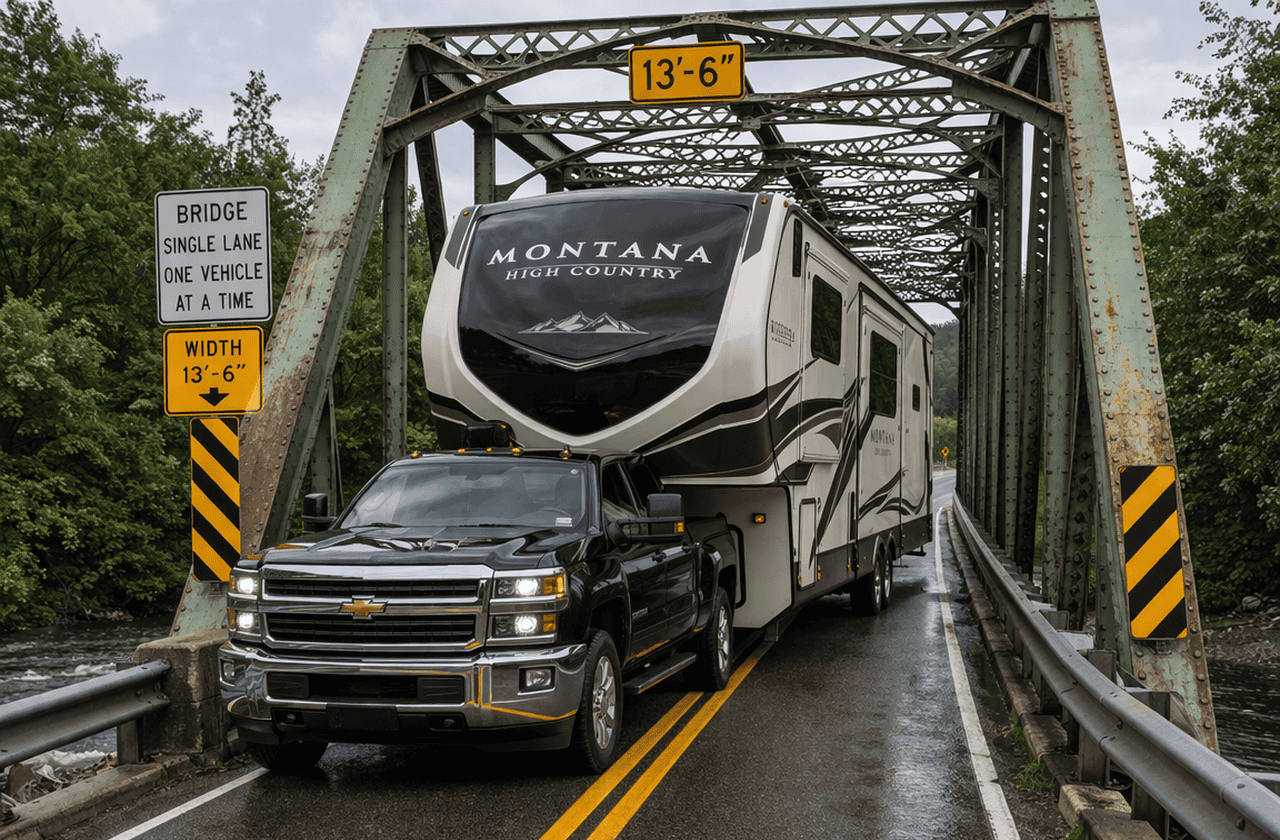
A bridge or border crossing that works fine for a passenger car may be a poor choice for a taller Class A, a long fifth wheel, or a high-profile trailer. With today's mapping technologies, it is easy to view the roads and lanes before you arrive at the border. At RVToad, before heading out we always check:
- Border wait times - Into Canada / Into USA
- Port hours - Into Canada / Into USA (Hours shown after ports selection)
- Bridge or tunnel restrictions
- Weather and wind advisories
- Whether your route is practical for your RV height, width, and length
Crossings That May Be a Bad Fit for Some RVs
One of the easiest mistakes RV travelers can make is letting GPS choose the border crossing without checking whether it makes sense for the size and profile of the rig.
Detroit–Windsor Tunnel
This route has vehicle limitations: a maximum height of 12'8" and width of 8'6", along with a reduced speed limit of 25 mph (40 km/h). Additionally, propane (LP) is not permitted in the tunnel, which makes this crossing unsuitable for most RVs. Instead, most travelers should consider using the Ambassador Bridge.
Thousand Islands Bridge
High winds can temporarily stop the crossing of high-profile vehicles, including RVs, buses, and some trailers. Make sure to check weather conditions before taking this route.
Whirlpool Rapids Bridge
This bridge is restricted to passenger vehicles with NEXUS cards for each occupant. It is not recommended for most RVers. A better alternative in the Niagara Falls area is the Queenston-Lewiston Bridge.
Peace Arch Crossing Surrey, BC / Blain, WA
The lanes are notoriously narrow at the WA to BC crossing, especially in NEXUS lanes. While RVs are allowed to cross at this checkpoint, it is primarily meant for passenger vehicle traffic. Obstacles are often set up to slow traffic which can make navigating harder with a large RV. A good alternative is the Pacific Highway Crossing, which is the commercial route just 2 miles to the East. Another alternative is the Sumas / Huntingdon crossing which has a Bus/RV lane.
St-Bernard-de-Lacolle
This major border crossing is currently undergoing construction. The Canada Border Services Agency state that the infrastructure redevelopment will carry on through Winter 2027. After completion, it should be a very smooth crossing with 8 new lanes opening.
What to Have Ready at the Border Booth
When you pull up to the inspection booth, being organized makes the experience much smoother. Keep these items within easy reach:
- Travel documents: passports or accepted IDs for everyone in the vehicle
- Pet documents: rabies certificates, CDC Dog Import Form receipt, microchip details, vet records
- Vehicle info: registration, insurance, destination details, campground reservation if applicable
- Goods to declare: food (remember to discard fresh produce before arriving at the border), pet food, alcohol, tobacco, gifts, agricultural items, and recent purchases
Build a Simple “Border Binder” for Your RV
In a passenger car, it is easy to keep everything in the glove box. In a motorhome, travel trailer, or truck camper, things get spread out fast. A dedicated border binder or document pouch keeps the process simple.
What to keep in it
- Passports for everyone
- Vehicle registration and proof of insurance
- Dog and cat rabies certificates
- CDC Dog Import Form receipt
- Dog microchip numbers
- Printed pet photos
- Vet contact information
- Campground reservations
- Receipts for recent purchases
- A short written list of food and pet food onboard

Official Resources and Links
These are the official pages readers should review before their trip. Government rules can change, so these pages are the best source of truth.
Canada Resources
Frequently Asked Questions
Do RVs use a special lane at the border?
Usually, No. Personal-use RVs are generally processed like other passenger vehicles unless signs or officers direct you elsewhere.
Do I need a rabies certificate for my dog or cat to enter Canada?
In most typical pet-travel situations, yes. A current rabies vaccination certificate is one of the most important documents to carry for a dog or cat entering Canada from the U.S. For Puppies and Kittens under 3 months, the most important document is proof of age.
Do I need a CDC form to bring my dog back into the U.S.?
While you don't need the form, you do need a receipt that you completed the form online. This lets agents know that your dog is officially in the system and ready to enter at the U.S. Border. They may also scan your dog for a microchip to confirm identity.
Can I bring pet food in my RV?
Usually yes, but you should declare it and keep it in original packaging whenever possible. Homemade pet food is generally not allowed.
Will my GPS choose the best border crossing?
In many cases, no. Always check the route first. Some crossings are much better than others for taller, wider, or high-profile RVs. Looking at border crossing wait times can help get you to your destination faster.
Final Thoughts
Crossing the U.S.–Canada border in an RV with pets is very doable when you prepare for both the human side and the animal side of the trip. Keep your documents organized, know your pet requirements before you leave, declare food and pet items honestly, and choose your crossing based on your RV size and conditions — not just convenience. A little prep can turn border day into a smooth part of the adventure instead of a stressful surprise.
Check out our additional articles on RVToad
- RVToad Flat towed Vehicle Database
- How To Protect Your Tow Vehicle Behind A Motorhome
- How to Hitch Up and Hit the Road
- Top 10 Best Flat Towable Vehicles for 2026
- Products Worth Buying for the Camping Season
- If you need a tow car for your travels: BUY A TOAD
- If you have a towed vehicle to sell, use the #1 towed vehicle marketplace: SELL A TOAD.